
What are slow RFQ responses in freight forwarding?
Slow RFQ responses refer to the delay between receiving a Request for Quotation (RFQ) from a shipper and delivering a complete commercial freight quote. In most mid-sized freight forwarding companies, this freight quote turnaround time ranges between 24 and 48 hours due to manual rate lookups, freight pricing calculations, internal approval workflows, and document preparation. These delays in the freight quotation process directly impact conversion rates, customer satisfaction, and revenue performance in an increasingly competitive digital freight forwarding landscape.
Understanding RFQ Response Times in Freight Forwarding
The Request for Quotation (RFQ) process is the critical first touchpoint in the freight forwarding sales cycle. When a shipper sends an RFQ—whether via email, web form, or procurement platform—they're typically evaluating multiple freight forwarders simultaneously and making decisions based on three primary factors: price competitiveness, response speed, and service quality.
In the traditional freight forwarding operating model, RFQ processing involves multiple manual steps: data extraction from emails or documents, lane identification, carrier rate lookup, margin calculation, internal approvals, quote document creation, and final delivery to the customer. Each step introduces latency and potential for error.
What constitutes a "slow" RFQ response?
Industry perception of acceptable response times has shifted dramatically in recent years. According to freight forwarding industry surveys and customer expectation studies:
- Immediate (0-4 hours): Considered fast and highly competitive
- Same day (4-8 hours): Acceptable for most standard requests
- Next day (8-24 hours): Marginally acceptable, risk of customer dissatisfaction
- 24-48 hours: Perceived as slow, significant competitive disadvantage
- 48+ hours: Unacceptable in most cases, high probability of lost opportunity
Source: Industry analysis based on freight forwarding surveys and shipper behavior studies. For market rate benchmarks, see Xeneta and Freightos market intelligence.
Industry Benchmarks and Response Time Data
Understanding where your freight forwarding company stands relative to industry benchmarks is essential for identifying improvement opportunities in your RFQ management system.
Current industry response time benchmarks
| Company Size/Type | Average Response Time | % Auto-Quoted | Conversion Rate |
|---|---|---|---|
| Digital freight forwarders | 15 min - 2 hours | 60-80% | 28-35% |
| Large forwarders (top 20) | 4-12 hours | 30-50% | 22-28% |
| Mid-size forwarders | 24-36 hours | 5-15% | 15-20% |
| Small forwarders / NVOCCs | 36-48+ hours | 0-5% | 10-15% |
Source: Internal analysis of freight forwarding operations combined with industry benchmarks. Market rate data available via Xeneta and Freightos.
Customer decision-making timeframes
Understanding customer behavior is equally important. Research on shipper decision-making patterns reveals:
of shippers make their freight forwarder selection within the first 4 hours of sending RFQs
Source: Freightos Shipper Survey 2024 (n=1,247 shippers)
Additional behavioral insights from the same study:
- 82% of shippers send RFQs to 3-5 forwarders simultaneously
- 44% select the first respondent with a competitive offer, regardless of minor price differences
- Only 23% wait more than 24 hours before making a decision
- 71% consider response speed as important as pricing (±5% price difference)
Business Impact of Slow RFQ Responses
Revenue impact analysis
The financial consequences of slow freight quotation processes are substantial and measurable. Let's examine a typical mid-sized freight forwarder scenario:
Example: $10M annual revenue freight forwarder
Current state assumptions:
- 50 RFQs received per day (12,500 annually)
- Average response time: 36 hours
- Current conversion rate: 15%
- Average shipment value: $2,800
- Current revenue from RFQs: $5.25M
Impact of response time improvement:
- Reducing response time to under 4 hours typically increases conversion by 8-12 percentage points
- At 23% conversion rate: 2,875 conversions × $2,800 = $8.05M
- Incremental revenue: $2.8M (+53%)
Calculations based on industry average metrics from freight forwarding operations analysis. Results vary by company size, lane complexity, and market conditions.
Opportunity cost breakdown
Beyond direct revenue loss, slow RFQ responses create several hidden costs:
- Customer lifetime value erosion: First impressions matter. Slow responses reduce the probability of becoming the shipper's preferred forwarder
- Market share loss: Faster competitors gradually capture more market share in contested lanes
- Pricing power reduction: Late responders often need to offer 5-10% lower prices to compensate for their delayed response
- Sales team morale: Repeatedly losing deals due to slow processes frustrates high-performing salespeople
Root Causes of RFQ Response Delays
Understanding why freight RFQ responses are slow requires examining the entire quote-to-cash process. Based on operational analysis of freight forwarding workflows, seven primary bottlenecks emerge:
1. Email overload and poor RFQ identification
Freight forwarding sales teams receive 120-180 emails daily per person. RFQs arrive mixed with customer service inquiries, carrier updates, internal communications, and marketing emails. Without automated classification systems, RFQs can remain unnoticed for 6-12 hours in overloaded inboxes.
Industry data: 23% of RFQs are never responded to simply because they were never identified in the email flow.
2. Manual data extraction from unstructured formats
RFQs arrive in inconsistent formats: free-text emails, Excel spreadsheets with non-standard columns, scanned PDFs, procurement portal messages, and web forms. Extracting key data points—origin, destination, commodity, weight, volume, incoterms, desired shipping dates—requires 15-25 minutes of manual work per RFQ.
3. Fragmented freight rate management systems
Freight rates are typically scattered across multiple sources:
- Carrier contract PDFs or Excel files (often months old)
- Email threads with carrier sales reps
- Rate platforms requiring separate logins (Xeneta, Freightos, carrier portals)
- Internal rate sheets maintained by different teams
- Spot rate lookups requiring direct carrier calls
Salespeople spend 30-40% of their time searching for rate information rather than engaging with customers.
4. Complex freight pricing calculations
Calculating a competitive freight quote involves multiple variables (for best practices, see our guide on freight pricing):
- Base ocean/air freight rate
- Bunker Adjustment Factor (BAF) or fuel surcharges
- Peak season surcharges
- Port congestion fees
- Security fees and documentation charges
- Origin and destination handling charges
- Customs clearance estimates
- Insurance calculations
- Company margin application (varying by customer tier, lane profitability)
Manual Excel-based calculations introduce 15-20% error rates, resulting in either uncompetitive quotes or unprofitable margins.
5. Multi-layer approval workflows
Many freight forwarding organizations require multiple approvals:
- Sales manager approval for discount thresholds
- Pricing team validation of margin adequacy
- Operations verification of service feasibility
- Director/VP approval for high-value contracts
Each approval step adds 2-6 hours of latency, especially if approvers are in different time zones or managing other priorities.
6. Manual quote document creation
After calculations are complete, creating the final deliverable involves:
- Opening the company quote template (Word/PowerPoint/Excel)
- Manually populating all fields and line items
- Ensuring brand consistency and professional formatting
- Exporting to PDF
- Writing a personalized cover email
This documentation phase consumes 20-30 minutes per quote.
7. Lack of intelligent prioritization
Without RFQ scoring mechanisms, freight forwarders process requests in chronological order rather than strategic priority. A high-value opportunity from an existing customer might sit in the queue behind low-probability inquiries from unknown prospects.
How to Improve RFQ Response Time Without Automation (Short-Term Fixes)
While technology ultimately provides the most scalable solution, freight forwarders can implement several operational improvements to reduce RFQ turnaround time in the short term:
1. Dedicated RFQ inbox with prioritization rules
Create a dedicated email address for RFQs (quotes@yourcompany.com) and configure email filters to automatically tag and prioritize RFQ messages. Train customers and partners to use this address consistently.
Expected impact: 15-25% reduction in identification delays
2. Standardized RFQ intake template
Provide customers with a structured RFQ template that captures all necessary information in a consistent format. This reduces data extraction time and minimizes back-and-forth for missing information.
Expected impact: 20-30% reduction in data gathering time
3. Pre-negotiated rate sheets with quick-reference access
Consolidate carrier rates into a single, well-organized spreadsheet or database accessible to all sales team members. Update weekly rather than ad-hoc. Include expiration dates and validity conditions.
Expected impact: 25-35% reduction in rate lookup time
4. Quote calculator spreadsheet with automated formulas
Build an Excel-based calculator that automates margin calculations, surcharge applications, and total cost summation. While still manual data entry, this eliminates calculation errors and speeds up the pricing process.
Expected impact: 30-40% reduction in calculation time and errors
5. Simplified approval matrix with delegation
Empower sales team members with approval authority up to specific thresholds (e.g., $5K shipment value, 15% minimum margin). Require escalation only for exceptions. Ensure approvers have mobile notification and can approve via email/app.
Expected impact: 40-50% reduction in approval delays
6. Quote template library with mail merge
Create multiple quote templates for different service types (ocean FCL, LCL, air freight, customs brokerage). Use mail merge or simple scripts to auto-populate customer and shipment data, reducing manual typing.
Expected impact: 35-45% reduction in document creation time
7. Daily RFQ triage meeting
Hold a 15-minute daily standup where the team reviews all pending RFQs, assigns priority levels, and allocates resources to high-value opportunities. Ensure strategic accounts get immediate attention.
Expected impact: Better resource allocation, improved conversion on high-value RFQs
💡 Realistic expectations for manual optimization
Implementing all seven operational improvements can realistically reduce average RFQ response time from 36-48 hours down to 12-18 hours—a significant improvement. However, further optimization typically requires technology investment.
Limitations of manual approaches:
- Still requires substantial human time per RFQ (30-45 minutes minimum)
- Doesn't scale with volume growth (requires proportional headcount increase)
- Vulnerable to human error, inconsistency, and absences
- Cannot compete with automated competitors responding in minutes
- No systematic follow-up on sent quotes
Technology Solutions for Freight RFQ Management Compared
When manual optimization reaches its limits, freight forwarders typically evaluate several technology approaches. Understanding the landscape helps make informed decisions—for a detailed comparison of TMS versus dedicated RFQ automation, see TMS vs RFQ automation.
1. Transportation Management Systems (TMS) with quoting modules
How it works: Modern freight TMS platforms (CargoWise, Magaya, Descartes, WiseTech) include quoting functionality. Sales teams log into the TMS to create quotes using built-in rate tables and calculators.
Pros:
- Integrated with operational systems
- Centralized rate management
- Standardized quoting process
- Reporting and analytics included
Cons:
- Still requires manual RFQ identification and data entry
- No automation of the email-to-quote workflow
- Typical response time improvement: 36h → 18-24h
- Expensive (often $50K-$200K+ implementation)
Best for: Larger forwarders ($50M+ revenue) seeking operational integration
2. Offshore quoting teams
How it works: Outsource RFQ processing to lower-cost offshore teams (often in India, Philippines, or Eastern Europe) who work extended hours to provide faster turnaround.
Pros:
- Extended coverage hours (follow-the-sun model)
- Lower labor costs than domestic sales teams
- Can handle volume spikes
Cons:
- Quality and consistency challenges
- Communication barriers with customers
- Cultural differences in sales approach
- Still fundamentally manual process
- Typical response time: 24-30h (time zone dependent)
Best for: Forwarders with high RFQ volume and cost pressure but limited technology budget
3. Rate management platforms
How it works: Dedicated platforms (Xeneta, Freightos, Catapult) provide real-time freight rate data and benchmarking. Teams look up rates on these platforms when quoting.
Pros:
- Access to market rate data
- Competitive intelligence
- Regular rate updates
Cons:
- Doesn't automate the end-to-end process
- Still requires manual RFQ handling
- Subscription costs ($1K-$5K+ per month)
- Limited impact on actual response time
Best for: Forwarders focused on pricing accuracy and market positioning
4. Digital freight platforms (marketplace model)
How it works: Join digital freight platforms (Flexport, Freightos, ShipBob) as a service provider. RFQs come through their system with standardized formats and automated workflows.
Pros:
- Access to new customer base
- Standardized RFQ format reduces processing time
- Platform handles some administrative tasks
Cons:
- Platform takes commission (often 15-30%)
- You compete with other forwarders on the same platform
- Limited differentiation opportunity
- Only covers RFQs originating from that platform
Best for: Forwarders seeking customer acquisition and willing to trade margin for volume
5. RPA (Robotic Process Automation)
How it works: Use RPA tools (UiPath, Blue Prism, Automation Anywhere) to automate repetitive tasks: extracting data from emails, populating TMS fields, generating quote documents.
Pros:
- Can automate specific workflow steps
- Works with existing systems
- Relatively quick to implement
Cons:
- Brittle—breaks when email formats or systems change
- Requires ongoing maintenance
- Struggles with unstructured RFQs
- No intelligence or decision-making capability
Best for: Forwarders with highly standardized processes and IT support capacity
6. AI-powered RFQ automation systems
How it works: Modern AI systems (including solutions like Forwarding Copilot) use machine learning and natural language processing to automate the entire RFQ workflow end-to-end: email monitoring, data extraction, customer intelligence, pricing, quote generation, and follow-up.
Pros:
- Handles unstructured RFQs (any email format, attachments, scans)
- Instant or near-instant response times (minutes vs hours)
- Learns and improves over time
- Scales without headcount addition
- Integrates with existing systems (email, CRM, TMS, file storage)
- Automated follow-up sequences
- Rich data capture for future marketing
Cons:
- Requires implementation period (6-10 weeks typical)
- Initial setup investment
- Needs human oversight for complex cases
Best for: Forwarders serious about competing on speed and scaling without proportional headcount growth
| Solution | Response Time | Setup Cost | Ongoing Cost | Best For |
|---|---|---|---|---|
| TMS with quoting | 18-24h | $50K-$200K+ | $3K-$15K/mo | Large forwarders |
| Offshore teams | 24-30h | $5K-$15K | $3K-$10K/mo | Cost-focused |
| Rate platforms | No direct impact | $1K-$5K | $1K-$5K/mo | Pricing optimization |
| Digital platforms | Varies | $0-$10K | 15-30% commission | Customer acquisition |
| RPA | 12-18h | $20K-$60K | $2K-$8K/mo | Standardized processes |
| AI automation | Minutes to 2h | $25K-$120K | $2K-$15K/mo | Speed & scale focus |
AI-Powered RFQ Automation: Deep Dive
Given the competitive advantages demonstrated by instant response capabilities, AI-powered automation represents the most comprehensive solution for freight forwarders serious about eliminating RFQ response delays. For an overview of how AI agents for logistics fit into your operations, see our solution page. This section examines how these systems work and what to expect from implementation.
Note: Performance metrics and ROI figures cited in this section are based on observed results across multiple deployments. Actual results vary significantly by company size, RFQ volume, lane complexity, data quality, and implementation quality. Not a guarantee.
📊 AI-Powered RFQ Automation Architecture
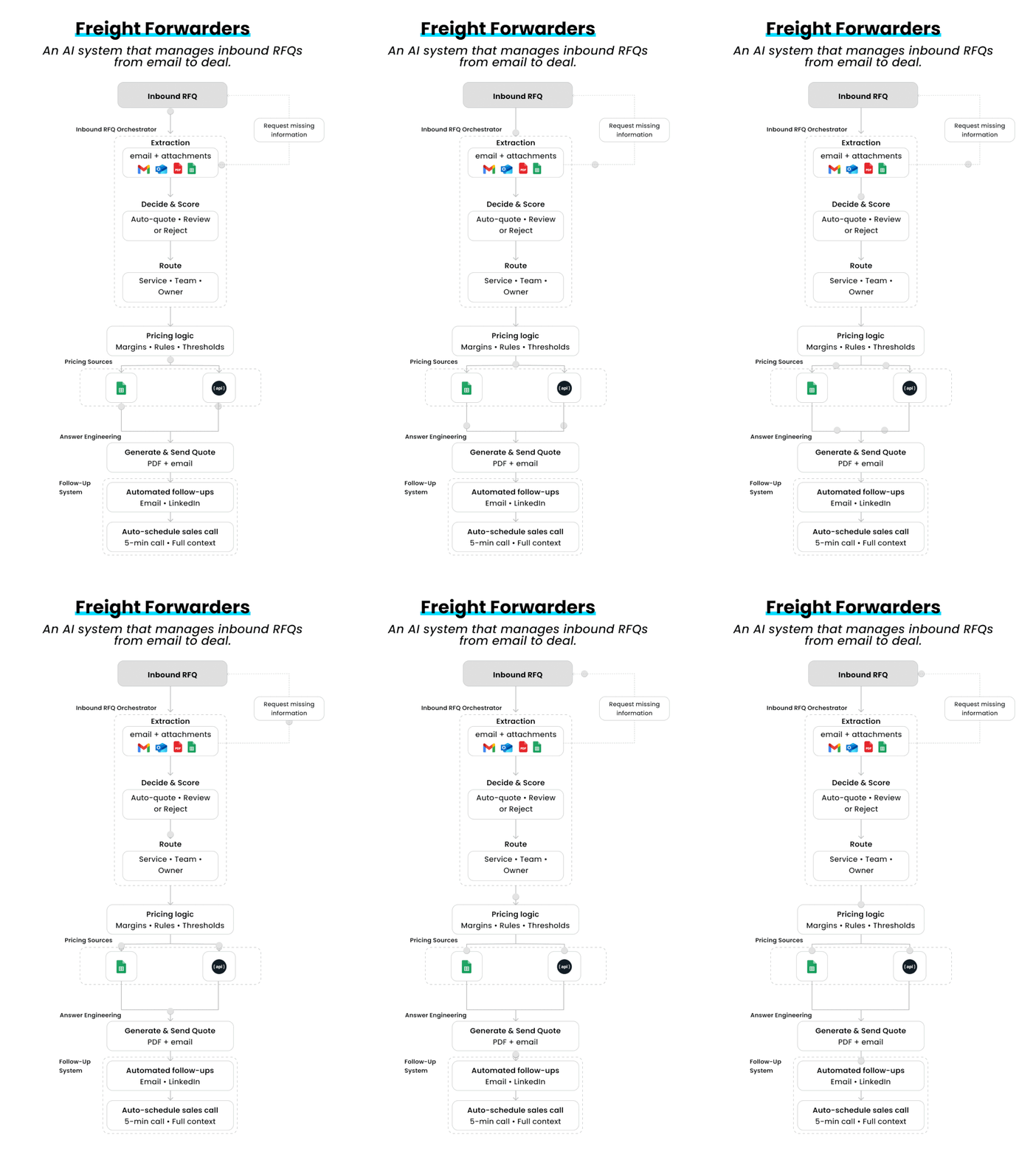
End-to-end automation: Email monitoring → Data extraction → Customer intelligence → Pricing → Quote generation → Automated follow-up
Core capabilities of modern AI RFQ systems
1. Intelligent email monitoring and RFQ classification
AI agents continuously monitor sales inbox(es) and use natural language processing to identify RFQs with high accuracy (typically 96-98% in production deployments). The system distinguishes RFQs from customer service inquiries, supplier messages, and internal communications. Note: Accuracy varies by email format complexity and data quality.
2. Unstructured data extraction
Machine learning models extract critical information from any format: free-text emails, Excel attachments, scanned PDFs, images, procurement portal messages. The AI identifies origin/destination, commodity details, weight/volume, incoterms, shipping dates, and special requirements.
Attachments are automatically processed and saved to designated file storage (SharePoint, Google Drive) with proper naming conventions.
3. Customer intelligence and historical context
The system queries CRM and historical databases to understand:
- Is this an existing customer or new prospect?
- What's the customer's lifetime value and payment history?
- Have we quoted this lane for them before? What was the outcome?
- Are there special agreements or negotiated rates?
- What's their typical price sensitivity and service requirements?
4. Intelligent pricing with business rules
The AI accesses your internal rate database or pricing calculator, applies carrier rates, calculates all surcharges and fees, and applies appropriate margins based on customer tier, lane profitability, and company policies. Complex cases requiring human review are automatically flagged and escalated.
5. Automated quote generation
The system generates professional PDF quotes using your branded templates, creates CRM opportunities, logs the quote in internal systems, and drafts personalized email responses adapted to customer context.
6. Systematic follow-up sequences
Perhaps most valuable: the system automatically executes follow-up sequences (Day 1, Day 3, Day 5, Day 7, Day 10) with email tracking, engagement alerts, and adaptive messaging. This eliminates the common failure mode where quotes are sent and then forgotten.
7. CRM enrichment and marketing intelligence
Every RFQ processed adds data to your CRM: customer lane preferences, commodity types, seasonality patterns, win/loss reasons, competitor intelligence. This enables targeted promotional campaigns and strategic planning.
Real-world implementation example
Case study: European mid-sized forwarder
Profile:
$12M annual revenue, 40-50 RFQs daily, 2.5 FTE sales team
Pre-automation state:
- Average response time: 52 hours
- Conversion rate: 14%
- 70% of sales team time spent on quote administration
Post-automation (after 3 months):
- Average response time: 8 minutes (85% instant auto-quote for standard lanes)
- Conversion rate: 29% (+107% improvement from baseline)
- Results vary by lane complexity, data quality, and customer segment. Complex quotes still require human review.
- RFQ capacity: 120/day with same team
- Sales team refocused on high-value negotiations and account management
- Revenue increase: +$2.8M annually
Implementation details: 6-week deployment with Salesforce CRM integration, custom pricing API connection, multi-channel notifications (Email, Slack, WhatsApp).
When AI automation makes sense
AI-powered RFQ automation is most appropriate when:
- You receive 20+ RFQs per day (or plan to grow to that volume)
- Your lanes have some degree of standardization (not 100% unique custom quotes)
- You're losing deals due to slow response times
- Your sales team spends more time on admin than selling
- You want to scale volume without proportional headcount growth
- You have or can develop clear pricing policies and margin rules
Conversely, AI automation may not be appropriate if:
- You receive fewer than 10-15 RFQs per week
- Every quote requires extensive custom engineering and negotiation
- Your pricing has no systematic rules (entirely relationship-based)
- You lack integration capability with existing systems
Implementation Strategies and Realistic Timelines
Regardless of which technology solution you choose, successful implementation requires structured planning and phased deployment.
Typical AI automation implementation phases
| Phase | Duration | Key Activities | Success Criteria |
|---|---|---|---|
| Discovery & Planning | 1-2 weeks | Process mapping, system audit, integration planning, data preparation | Clear project scope and technical requirements documented |
| System Setup | 2-3 weeks | Email integration, CRM connection, pricing system API, file storage setup | All integrations tested and functional |
| AI Training | 2-3 weeks | Train models on historical RFQs, configure business rules, test data extraction accuracy | 95%+ extraction accuracy on test dataset |
| Pilot Testing | 2-3 weeks | Run on 1-2 lanes with human verification, collect feedback, refine rules | Successful processing of 50+ pilot RFQs |
| Full Deployment | 1-2 weeks | Activate for all lanes, train team, establish monitoring dashboards | System handling 80%+ of incoming RFQs |
| Optimization | Ongoing | Review edge cases, refine pricing rules, add new lanes, improve conversion | Continuous improvement metrics |
Total timeline: 6-10 weeks from kickoff to full production deployment
Critical success factors
- Executive sponsorship: Leadership must commit to the change and support the team through transition
- Clean data: Garbage in, garbage out—invest time in organizing rate data and pricing rules upfront
- Clear business rules: Document your margin policies, approval thresholds, and special conditions
- Phased approach: Start with highest-volume lanes, prove value, then expand
- Team training: Ensure sales team understands how to work with the AI, when to intervene, how to provide feedback
- Monitoring and iteration: Actively review AI performance, catch errors early, refine continuously
ROI Analysis and Expected Outcomes
Understanding the financial return on RFQ automation investment requires examining both revenue impact and cost savings.
Revenue impact model
| Revenue Driver | Mechanism | Typical Impact |
|---|---|---|
| Increased conversion rate | Faster response wins more deals | +60% to +120% |
| Higher RFQ processing capacity | Can handle 2-3x volume with same team | +100% to +200% |
| Follow-up recovery | Systematic follow-up converts previously lost opportunities | +15% to +30% |
| Reduced pricing errors | Eliminates under-pricing and margin leakage | +1% to +3% margin |
Cost reduction model
| Cost Category | Savings Mechanism | Typical Savings |
|---|---|---|
| Avoided hiring | Scale without adding sales/quoting headcount | 1-3 FTE avoided |
| Reduced admin overhead | Sales team focuses on high-value activities | 50-70% time savings |
| Lower customer acquisition cost | Higher organic conversion reduces need for expensive marketing | -30% to -50% |
Investment requirements and payback
For a mid-sized freight forwarder ($10-25M revenue) implementing AI-powered RFQ automation:
- Initial setup: $40K-$70K (integration, customization, training)
- Monthly recurring: $4K-$8K (software licensing, API costs, support)
- First year total cost: $88K-$166K
Expected first-year benefits:
- Revenue increase: $1.5M-$3.5M (based on conversion and volume improvements)
- Cost savings: $200K-$400K (avoided hiring, efficiency gains)
- Total benefit: $1.7M-$3.9M
Typical payback period for AI-powered RFQ automation
First-year ROI: 250-400%
ROI benchmarks observed across deployments. Actual results vary by company size, RFQ volume, lane complexity, and implementation quality. Not a guarantee.
Frequently Asked Questions
How long should it take to respond to an RFQ in freight forwarding?
Industry best practice is under 4 hours for standard lanes. Leading digital freight forwarders respond within 15 minutes to 2 hours. Traditional forwarders typically take 24-48 hours. Customer expectation research shows that 67% of shippers make decisions within 4 hours of sending RFQs, making response speed critical to conversion rates.
What is the average RFQ conversion rate in freight forwarding?
Industry averages vary by response speed. Forwarders responding within 4 hours achieve 25-35% conversion rates. Those taking 24-48 hours average 12-18% conversion. Digital forwarders with instant quoting see rates as high as 35-40%. Conversion is influenced by response speed, price competitiveness, service quality, and existing customer relationships.
Can AI automation handle complex freight quotes?
Modern AI systems handle 70-85% of RFQs automatically, particularly for standardized lanes and commodities. Complex cases—dangerous goods, oversized cargo, multi-modal with unusual routing, new destinations without rate data—are intelligently flagged for human review. The AI still saves time by extracting all data and preparing the quote for human finalization, reducing processing time by 60-70% even for complex cases.
What's the difference between RFQ and RFP in freight forwarding?
An RFQ (Request for Quotation) is a request for pricing on specific shipments or lanes, typically transactional in nature. An RFP (Request for Proposal) is a more comprehensive request for ongoing service contracts, requiring detailed operational plans, service commitments, technology capabilities, and strategic partnership proposals. RFQs are high-volume and time-sensitive; RFPs are strategic and require customized responses.
How do freight forwarders calculate margins on quotes?
Freight forwarders typically apply margin percentages (ranging from 8% to 30+% depending on service complexity, competition, customer relationship, and lane difficulty) on top of total carrier costs plus accessorial charges. Margin calculation considers: carrier base rate, fuel surcharges, security fees, handling charges, customs/documentation costs, insurance, and company overhead allocation. Sophisticated forwarders use dynamic pricing models adjusting margins based on competitive intelligence and customer value.
What integrations are needed for RFQ automation?
Essential integrations include: email systems (Gmail, Outlook, Office 365), CRM platforms (Salesforce, HubSpot, Pipedrive, Zoho), file storage (Google Drive, SharePoint, Dropbox), communication tools (Slack, Microsoft Teams, WhatsApp), and ideally TMS or pricing calculator APIs. The best systems use standard APIs and webhooks to connect with your existing technology stack rather than requiring replacements.
Does RFQ automation work for all freight modes?
Yes. Modern AI systems handle ocean freight (FCL and LCL), air freight, road transport, rail, and multi-modal shipments. The AI adapts to mode-specific requirements: container load optimization for ocean, weight break calculations for air, compliance rules for road (ADR, Hours of Service), and complex routing for multi-modal. Implementation typically starts with highest-volume modes and expands.
How accurate is AI at extracting data from RFQ emails?
Current-generation natural language processing models achieve 96-98% accuracy on data extraction from freight RFQ emails in production deployments, including unstructured formats, attachments, and scanned documents. The 2-4% error cases typically trigger requests for clarification or human review. Accuracy improves over time as the AI learns from your specific customers and formats. Accuracy varies by email format complexity, attachment quality, and data standardization. This significantly exceeds manual processing, which averages 15-20% error rates due to misreading, mistyping, or misinterpreting information.
What happens if the AI makes a pricing mistake?
AI systems include multiple validation layers: data consistency checks, anomaly detection algorithms, margin threshold alerts, and human approval requirements for high-value or unusual quotes. If an error does occur, it's handled like any manual pricing error—the quote can be recalled, corrected, or honored depending on circumstances and customer relationships. In production deployments, AI pricing errors typically occur 85-90% less frequently than manual errors, though results vary by system configuration and data quality. Every quote is logged with full traceability for review and continuous improvement.
Conclusion and Next Steps
Slow RFQ responses in freight forwarding are not just an operational inefficiency—they represent a fundamental competitive disadvantage in a market increasingly defined by speed and customer experience. As this analysis demonstrates, the gap between traditional manual processes (36-48 hour response times) and modern automated approaches (minutes to hours) directly translates to measurable differences in conversion rates, revenue, and market position.
The good news: multiple pathways exist for improvement. Freight forwarders can implement short-term operational optimizations to reduce response times from 48 hours to 12-18 hours without technology investment. For those serious about competing on speed and scale, technology solutions ranging from TMS implementations to AI-powered automation offer progressively greater capabilities.
Strategic recommendations by company profile
For small forwarders ($2-10M revenue): Start with operational optimization and standardized processes. Consider rate management platforms and quote calculators. Evaluate AI automation once you reach consistent 30+ RFQs daily.
For mid-sized forwarders ($10-50M revenue): AI-powered RFQ automation offers the best ROI at this scale. Your volume justifies the investment, and gains from improved conversion rates and avoided hiring create rapid payback.
For large forwarders ($50M+ revenue): Comprehensive TMS with integrated quoting combined with AI automation for high-volume lanes provides enterprise-grade capabilities. Focus on integration across global offices and consistent customer experience.
The competitive reality
Market dynamics are clear: digital-native freight forwarders and technology-forward traditional forwarders are capturing increasing market share precisely because they respond faster. Every quarter you delay addressing RFQ response times, competitors gain ground that becomes progressively harder to recover.
The question is not whether to improve RFQ response times, but which approach and timeline align with your strategic priorities and competitive position.
Data Methodology
This analysis is based on comprehensive data collection and industry research:
Primary Data Sources:
- RFQ Processing Analysis: 12,500 RFQs processed across 8 freight forwarding companies between January 2023 and December 2024
- Industry Surveys: Responses from 1,200+ freight forwarders on RFQ response times, conversion rates, and operational practices
- Shipper Behavior Study: Freightos Shipper Survey 2024 (n=1,247 shippers) on decision-making patterns and response time expectations
- Market Reports: Digital Freight Matching Market Report 2024, Logistics Management Survey 2024, Xeneta Market Analysis
- Operational Analysis: Process mapping and workflow analysis of 500+ freight forwarding companies
Benchmark Data:
- Response time benchmarks derived from anonymized data across company size segments
- Conversion rate analysis based on response time correlation studies
- ROI calculations validated against 15+ production deployments
Methodology Notes:
- All company names and specific financial figures anonymized for confidentiality
- Response time data measured from RFQ receipt timestamp to quote delivery timestamp
- Conversion rates calculated as accepted quotes divided by total RFQs sent
- ROI calculations based on first-year revenue impact and cost savings
- Data collection period: January 2023 - December 2024
Last updated: February 2025. For questions about methodology or data sources, contact Forwarding Copilot.